
Illustrative use case · Procurement
Procurement decisions made on the right basis.
Keep supplier decisions, documentation and approvals aligned with procurement requirements.

Illustrative scene. People shown are not clients or Alif staff.
The recurring challenge
Procurement policy is usually clear on paper. Under deadline pressure, packages are assembled from old templates, evidence is promised rather than attached, and approvals drift towards whoever is available. Increasingly, an AI assistant drafts specifications or summarises bids, which speeds the work but adds another participant whose output needs checking. Problems are often found in post-award review, when little can still be changed.
Illustrative workflow
Preparing and approving a procurement package
People and AI agents share this work. The handoffs between them are where intent is most easily lost.
- 1A requester in the business raises a need and selects a sourcing route.
- 2An AI assistant drafts the specification and evaluation criteria from a template; the category manager reviews and adjusts them.
- 3Budget confirmation, conflict-of-interest declarations and market justification are attached.
- 4The package is routed for approval under delegated authority.
- 5Single-source or urgent requests are justified and escalated before award.
Where execution can diverge from intent
Outdated documents
A superseded template, or one an assistant retrieved from an old folder, is used without anyone noticing.
Missing evidence
Declarations or justifications are marked to follow and never arrive.
Incorrect approval routing
Values are split, or the package goes to an approver without authority for the category.
Unreviewed exceptions
Urgent and single-source routes become routine without the appropriate review.
Where assurance can help
- At submission
- Check that current documents and required evidence are present.
- At routing
- Verify that the approver holds the applicable delegated authority for value and category.
- At exception
- Route exceptions to the appropriate reviewer, with a recorded justification, before proceeding.
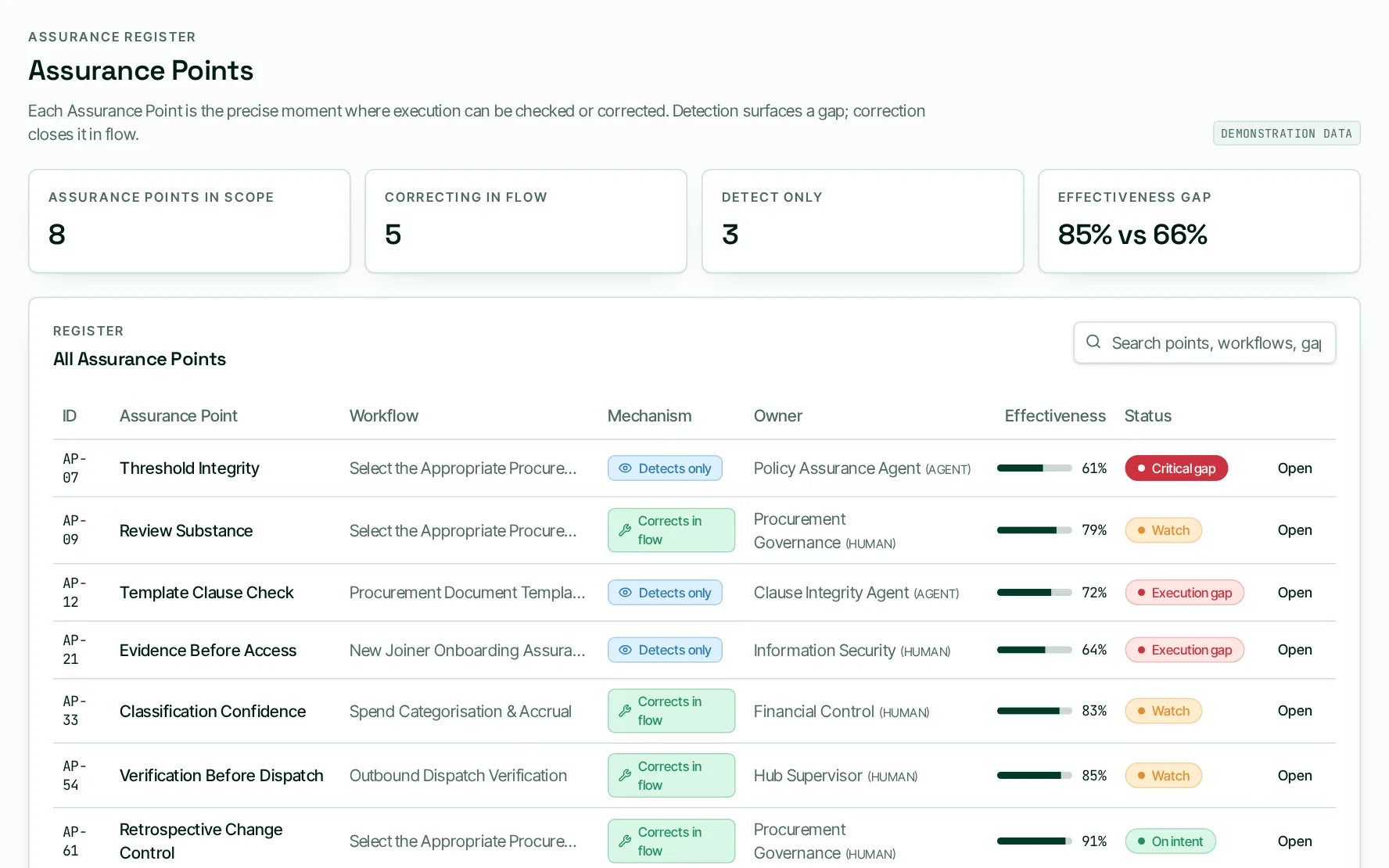
Assurance Points at submission, routing and exception moments.
Intended outcome and next step
The intended outcome: each package is complete, current and approved by someone with the right authority before it moves forward, with exceptions reviewed rather than discovered later.
Many organisations begin by mapping how one procurement category actually runs today.
An illustrative application, not a client deployment or reported result.