
AI agent assurance
AI agents working within the brief you set.
Keep agents within their intended purpose, information sources, authority and escalation boundaries.
The recurring challenge
An agent can perform well in a demonstration and still behave differently in live work. It may draw on unapproved information, take an action it was never meant to take, or answer when it should have handed over to a person.
Illustrative workflow
an agent handling supplier enquiries
People and AI agents share this work. The handoffs between them are where intent is most easily lost.
- 1The agent receives an enquiry about an invoice or payment status.
- 2It retrieves information from approved finance and supplier records.
- 3It drafts a response or proposes an action, such as updating contact details.
- 4Consequential actions require human approval.
- 5Disputes, unusual requests and low-confidence cases are escalated to the finance team.
Where execution can diverge from intent
Wrong information
The agent uses an outdated document or an unapproved source.
Excess authority
It proposes or performs an action beyond its permissions.
Missed escalation
A dispute or sensitive request is handled without involving a person.
Silent drift
Behaviour changes after an instruction, tool or model update.
Where assurance can help
- Information
- Confirm responses draw on approved, current sources.
- Consequential actions
- Require approval before changes to records or payments.
- Escalation
- Check that defined triggers route cases to the right team.
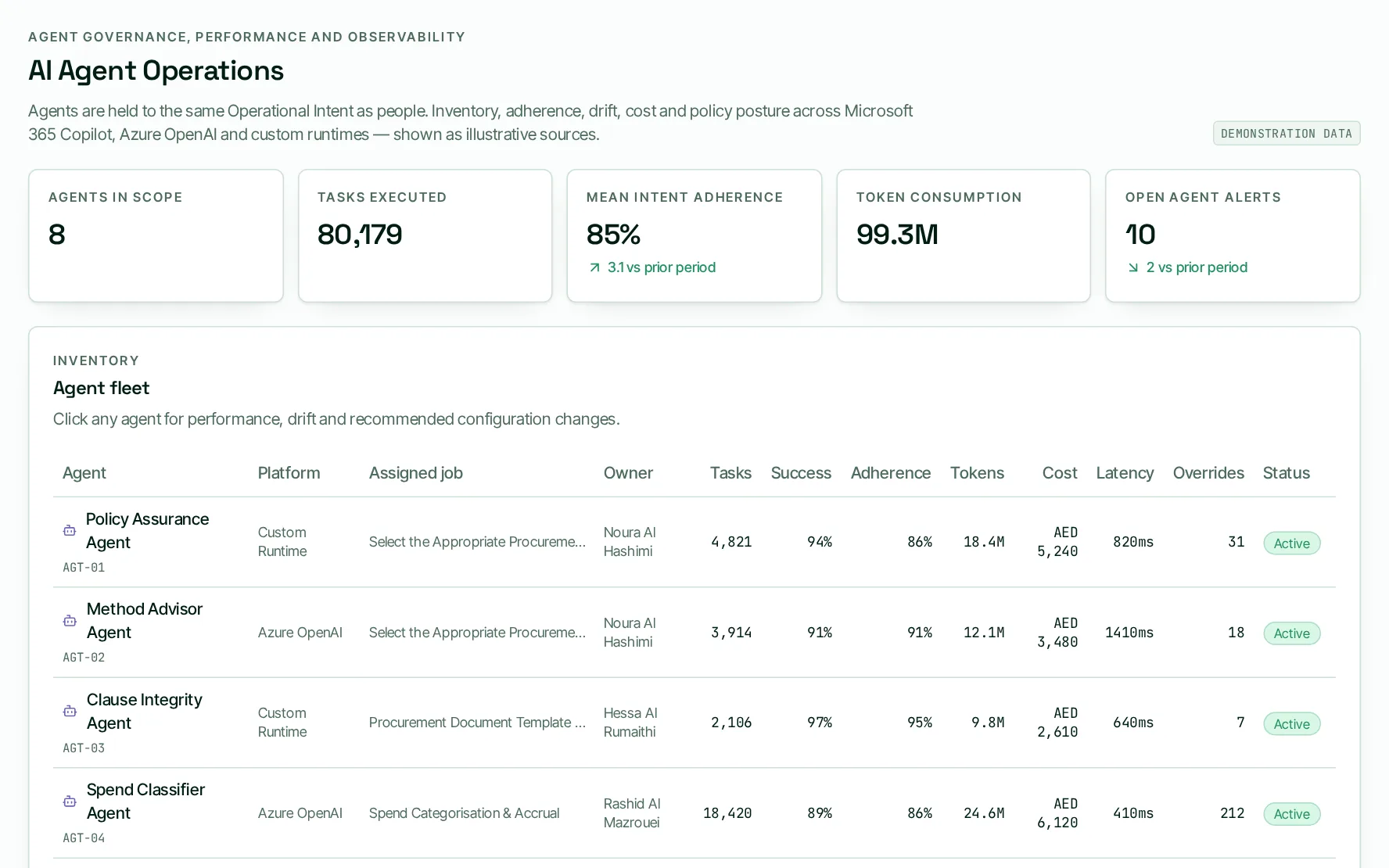
Agent jobs, ownership, adherence and human overrides in one view.
What you can see
- Which agents are operating within intent, and where overrides cluster
- Escalations that should have happened but did not
- How behaviour changes after configuration updates
What Alif helps you do
- Define each agent’s purpose, permissions, sources and escalation
- Test behaviour against routine, ambiguous and out-of-scope requests
- Recommend changes to instructions, tools or oversight
- Assess whether changes improve behaviour in operation
Intended outcome and next step
The intended outcome is confidence that each agent stays within its intended purpose, information sources, authority and escalation boundaries—and that exceptions reach a human in time.
A focused starting point is an audit of one agent in one workflow.
An illustrative application, not a client deployment or reported result.